Student Housing in Japan: Dorms vs Share Houses vs Apartments 2026
Find student housing in Japan: compare dorms, share houses, and apartments. Costs, neighborhoods, and rental tips for international students.
Navigating Your Home in Japan: The Ultimate Student Housing Guide
Congratulations! Deciding to study abroad in Japan is a life-changing step filled with the promise of academic growth, cultural discovery, and unforgettable memories. However, before you can dive into the neon-lit streets of Tokyo, explore the historic temples of Kyoto, or enjoy the street food of Osaka, you have one crucial puzzle to solve: finding a place to live.
For international students, navigating the Japanese housing market can feel overwhelming. The terminology is unique, the upfront costs can be high, and the rental culture may be vastly different from your home country. Broadly speaking, you will choose between three primary housing paths: University Dormitories, Share Houses, and Private Apartments.
In this comprehensive guide, we will break down each option in detail, compare their costs and lifestyles, explain tricky Japanese rental jargon, and help you select the perfect sanctuary for your study-abroad journey.
1. University Dormitories (Ryū): The Soft Landing
For many international students, the university dormitory (known in Japanese as Ryo / 寮) is the most natural starting point. Most Japanese universities offer dedicated housing for international students, either managed directly by the institution or run in partnership with private student-housing companies (such as Kyoritsu Maintenance's "Dormy" network).
The Lifestyle and Social Dynamic
Dormitories are designed to ease your transition into Japanese society. You are placed in an environment surrounded by peers who are going through the exact same journey. This makes making friends incredibly easy. Many dorms organize cultural exchange events, welcome parties, and seasonal outings.
Depending on the dormitory structure, you might have a private bedroom while sharing a kitchen, dining hall, shower rooms, and laundry facilities with other residents. Some traditional dorms still employ a Kanrin (dorm manager) who lives on-site to assist students, receive packages, and ensure safety.
The Financial Picture
Dormitories are almost always the most budget-friendly option, especially when factoring in startup costs.
* Upfront Costs: Minimal. You rarely have to pay key money or agent fees. Usually, a small deposit or entrance fee is all that is required.
* Monthly Expenses: Rent is heavily subsidized by the university. Utilities (water, gas, electricity) and high-speed internet are typically included in a flat monthly fee.
* Furnishing: Your room will come pre-furnished with essential items: a bed, desk, chair, wardrobe, and often a small refrigerator.
Pros and Cons of Dormitory Living
Pros:
* Ultimate Convenience: Usually located on or very close to campus, saving you time and money on daily commutes.
* Low Barrier to Entry: Applications are handled directly through your university’s international office, often before you even arrive in Japan. No Japanese guarantor required.
* Built-in Community: Immediate social circle of local and international students.
* Optional Meal Plans: Many dorms offer affordable breakfast and dinner plans, saving you the hassle of daily cooking.
Cons:
* Strict Rules and Curfews: Many traditional Japanese dorms enforce strict curfews (often around 11:00 PM or midnight), lock out guests of the opposite sex, and have quiet-hour regulations.
* Limited Privacy: Shared bathrooms and kitchens mean you will have to compromise on personal space.
* Limited Tenancy: Most universities limit your stay in a dorm to six months or one academic year to allow incoming freshmen to utilize the rooms.
2. Share Houses (シェアハウス): The Modern Community
If you want a balance between social connection and independent living without the rigid rules of a school dormitory, a share house is an exceptional alternative. Over the last decade, share houses have exploded in popularity among both young Japanese professionals and international students. Major operators like Oakhouse, Borderless House, and Social Apartment have revolutionized this sector.
The Lifestyle and Social Dynamic
Share houses offer a unique, communal lifestyle. You occupy a private room (fully furnished) but share stylish, expansive common areas. Unlike basic university dorms, modern share houses often feature premium amenities: spacious lounge areas, cinema rooms, co-working spaces, and fully equipped kitchens with state-of-the-art appliances.
Living in a share house is highly multicultural. For example, companies like Borderless House maintain a strict 50-50 ratio of Japanese nationals to international residents. This guarantees that you can practice your Japanese daily while sharing your own culture with others.
The Financial Picture
Share houses sit comfortably in the middle tier of pricing.
* Upfront Costs: Exceptionally low. There is no key money or agency fee. Usually, you only pay a one-time administrative fee (typically around ¥30,000 to ¥50,000) and your first month’s rent.
* Monthly Expenses: Rent is higher than a university dorm but lower than a private apartment when utilities are factored in. Utilities are charged as a flat fee (roughly ¥10,000 to ¥15,000 per month), which simplifies budgeting.
* Furnishing: Fully furnished rooms make this a turn-key solution. You can move in with nothing but your suitcase.
Pros and Cons of Share House Living
Pros:
* High Interactivity: Perfect for language acquisition and making lifelong friends from around the world.
* Contract Flexibility: Lease terms are highly flexible. You can often rent month-to-month or on short-term 3-month contracts, making it ideal for exchange students.
* Worry-free Maintenance: Professional cleaning companies usually clean the shared areas (kitchens, bathrooms, hallways) weekly.
* No Guarantor Needed: The application process is streamlined for foreigners, completely bypassing the complex Japanese guarantor system.
Cons:
* Shared Responsibilities: You must clean up after yourself in communal kitchens and respect shared space rules.
* Noise and Friction: Living with 10 to 50 people means dealing with varying lifestyles, sleep schedules, and cleanliness standards.
* Shared Showers/WCs: Peak morning hours can lead to wait times for showers and laundry machines.
3. Private Apartments (アパート/マンション): Complete Independence
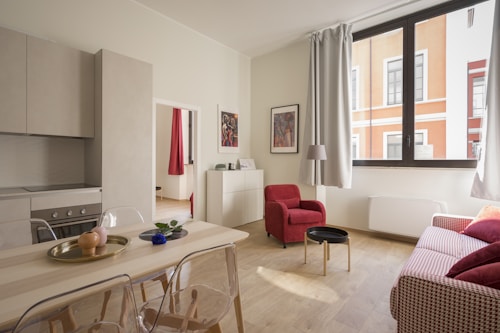
For those who crave absolute privacy, quiet study spaces, and the freedom to build a home exactly how they want it, renting a private apartment is the ultimate goal. In Japan, rental apartments generally fall into two structural categories: Apart (wooden or light-gauge steel frame buildings, usually 2 stories) and Mansion (reinforced concrete buildings, larger, quieter, and more expensive).
The Lifestyle and Social Dynamic
Renting your own apartment gives you 100% independence. There are no curfews, no shared kitchens, and no chore schedules. Your space is entirely your own. You can invite friends over whenever you wish (within reasonable noise limits) and decorate the space to match your personal aesthetic.
However, this independence can occasionally lead to isolation. Unless you actively join university clubs, volunteer, or socialize outside, living alone in a busy city like Tokyo can sometimes feel lonely.
The Financial Picture (The "Upfront Cost" Hurdle)
This is where private apartments can be intimidating for students. The traditional Japanese rental system requires significant upfront capital. When signing a lease, you must be prepared to pay several fees, many of which are non-refundable.
Here is a breakdown of what you might encounter:
1. Shikikin (敷金 - Security Deposit): Usually 1 to 2 months' rent. It is used for repairs when you move out, and the remainder is refunded.
2. Reikin (礼金 - Key Money): Literally "gratitude money." This is a non-refundable gift to the landlord, usually 1 to 2 months' rent. This practice is slowly dying out, but still common.
3. Chukai-tesuryo (仲介手数料 - Agency Fee): Usually 0.5 to 1 month’s rent paid to the real estate agent.
4. Guarantor Company Fee (保証会社利用料): Most landlords require a Japanese guarantor. If you do not have a relative in Japan, you must pay a guarantor company to vouch for you. This costs around 50% to 100% of one month's rent.
5. Fire Insurance & Key Exchange Fee: Usually around ¥20,000 each.
Note: In total, the startup cost for a private apartment can easily equal 4 to 6 months of rent upfront.
Pros and Cons of Private Apartments
Pros:
* Total Privacy: No sharing of kitchens, bathrooms, or living spaces.
* No Curfews or Visitors Restrictions: Complete control over your daily schedule and lifestyle.
* Choice of Location: You can choose exactly which neighborhood, train station, and street you want to live on.
Cons:
* Astronomical Initial Costs: Requires significant savings before arriving in Japan.
* Completely Unfurnished: Most apartments in Japan do not come with light fixtures, curtains, a refrigerator, a washing machine, or a bed. You must purchase and install everything yourself.
* Complex Contracts & Language Barrier: Most landlords require intermediate to advanced Japanese language skills, or you must work with specialized expat-friendly agencies.
* Utility Setup: You must personally call and set up electricity, water, gas, and internet contracts in Japanese.
4. Head-to-Head Comparison Matrices
To help you visualize how these three options stack up against each other, we have compiled two comparative tables outlining the financial realities and lifestyle logistics of each choice.
Table 1: Financial Breakdown & Setup Requirements
| Feature | University Dormitory (Ryū) | Share House | Private Apartment |
|---|---|---|---|
| Average Monthly Rent | Low (¥30,000 - ¥60,000) | Medium (¥50,000 - ¥85,000) | High (¥65,000 - ¥110,000+) |
| Initial Upfront Costs | Very Low (¥10,000 - ¥30,000) | Low (¥30,000 - ¥50,000 fee) | Very High (4x to 6x monthly rent) |
| Guarantor Required? | No | No | Yes (Usually Guarantor Company) |
| Furniture & Appliances | Included | Included | Not Included (Must buy own) |
| Utilities & Internet | Included in flat fee | Included in flat fee | Paid separately (User setups) |
| Contract Flexibility | Fixed (6 - 12 months) | Highly Flexible (1 - 6 months) | Long-term (Usually 2-year lease) |
Table 2: Lifestyle & Everyday Living Logistics
| Lifestyle Aspect | University Dormitory (Ryū) | Share House | Private Apartment |
|---|---|---|---|
| Privacy Level | Low to Medium | Medium | Maximum |
| Social Opportunities | High (Daily interaction) | High (Structured community) | Low (Requires self-effort) |
| Language Barrier | Low (Uni staff assists) | Low (Multi-lingual operators) | High (Japanese lease/admin) |
| Rules & Curfews | Strict (Common) | Moderate (House rules apply) | None (Standard neighbor etiquette) |
| Maintenance & Cleaning | Staff cleans common areas | Shared or professional cleaning | Entirely your responsibility |
| Ideal Student Type | Budget-conscious freshers | Social butterflies, medium budget | Independent, long-term scholars |
5. Step-by-Step Selection Guide: Which is Right for You?
Choosing where to live shouldn't be a guessing game. Use this structured decision guide to align your personality, budget, and language ability with the right housing choice.
- Is your budget tight (under ¥60k/month)?
- Yes → University dormitory
- No → Continue below
- Do you want to practice Japanese with roommates?
- Yes → Share house
- No → Continue below
- Do you need full privacy (no shared spaces)?
- Yes → Private apartment
- No → Share house is usually the better fit
Actionable Steps for Your Housing Search:
- Analyze Your Budget Realistically:
Remember that Tokyo is significantly more expensive than cities like Fukuoka, Sendai, or Kyoto. If your budget is under ¥60,000 per month and you are studying in Tokyo, a private apartment is virtually impossible unless you live very far from the city center. A dorm or share house is your best bet. - Evaluate Your Language Proficiency:
If you are a beginner (N5/N4), navigating a Japanese real estate agency (Fudousan) is incredibly difficult. Stick to university housing or foreign-friendly share house companies that provide support in English, Chinese, or Korean. - Check Your University's Housing Policies:
Some universities guarantee housing for all exchange students for their first semester. Always apply for this first! Even if you want to move into your own apartment later, starting in a dorm gives you a safe "soft landing" while you search for apartments locally. - Understand Key Rental Vocabulary:
Keep this glossary handy during your search:- Kyoiki-hi (共益費): Common area maintenance fee, added to your monthly rent.
- Tetsurou-kin (手付金): Holding deposit to reserve an apartment.
- Shin-shiki (新築): Newly built property (usually commands premium rent).
- Madori (間取り): Room layout. You will see terms like 1K (one room + separate kitchen), 1DK (one room + dining kitchen), or 1R (one room studio where the kitchen is in the main living space).
Closing Encouragement
Finding a home in Japan is your first major victory as an international student. Whichever option you choose—the bustling, collaborative environment of a university dormitory, the vibrant and cosmopolitan lifestyle of a share house, or the peaceful independence of your own private apartment—your housing will shape your study-abroad experience in beautiful ways.
Take your time, calculate your finances carefully, and don't hesitate to reach out to your university's international support desk or reputable English-speaking housing agencies.
Welcome to Japan, and may your new room be the launchpad for the adventure of a lifetime! Ganbatte kudasai! (Good luck!)
함께 보면 좋은 유학 가이드
이 페이지가 도움이 되었나요?
피드백은 콘텐츠 개선에 활용합니다