Kyoto Min-Sai Japanese Language School
京都府京都市右京区西京極北大入町69
🏫 Kyoto Min-Sai Japanese Language School: Your Gateway to Academic Success in Japan's Cultural Capital
Choosing the right Japanese language school is one of the most critical decisions you will make on your study-abroad journey. If your goals include entering a prestigious Japanese university, mastering practical communication, or pursuing a science-based degree in Japan, Kyoto Min-Sai Japanese Language School (京都民際日本語学校) stands out as a premier institution.
Located in the historic and academic city of Kyoto, Kyoto Min-Sai blends rigorous academic preparation with a warm, community-focused environment. With a capacity of 542 students, the school is large enough to offer specialized tracks and extensive support services, yet small enough to provide personalized guidance to every student. The name "Min-Sai" (民際) translates to "grassroots international exchange," reflecting the school's deep-rooted philosophy of connecting international students directly with the local Japanese community.
🗺️ School Overview & Philosophy
Kyoto Min-Sai Japanese Language School was founded on the belief that language learning should not be confined solely to the classroom. To truly master Japanese, students must engage with the culture, the people, and the local community. The school's philosophy centers on fostering global citizens who can act as bridges between their home countries and Japan.
Living and Learning in Nishikyogoku, Kyoto
The school is situated at 69 Nishikyogoku Kitaoiri-cho, Ukyo-ku, Kyoto. Unlike the crowded, tourist-heavy districts of central Kyoto, Ukyo-ku offers a peaceful, authentic residential setting. The neighborhood is famous for the Nishikyogoku Athletic Park, a major sports complex hosting athletics, baseball, and soccer events, surrounded by beautiful green spaces.
This location offers the perfect balance for students:
* A Quiet Study Environment: Free from the distractions of heavy commercial zones, allowing you to focus entirely on your academics.
* Incredible Accessibility: The school is a short distance from the Hankyu Kyoto Line (Nishikyogoku Station). From there, you can reach the bustling downtown area of Shijo-Kawaramachi in under 10 minutes, or travel directly to Osaka (Umeda) in about 40 minutes.
* A True "Student City" Vibe: Kyoto is home to over 30 universities and colleges, meaning the city is highly adapted to student life, offering affordable cafes, second-hand shops, and extensive bicycle paths.
📚 Courses, Curriculum & Teaching Style
Kyoto Min-Sai offers a structured, highly effective curriculum designed to take students from absolute beginners to fluent speakers and successful examinees. Whether your goal is to advance to higher education or to acquire Japanese for personal or professional growth, there is a specific pathway for you.
Course Offerings and Tuition Fees
Below is the official course schedule and total fee structure. Please note that total fees generally represent the full tuition, registration, and facility costs for the duration of the respective course program.
| Course Name | Admission Month | Total Fees (JPY) | Key Focus & Target Audience |
|---|---|---|---|
| Academic Course I (進学コース Ⅰ) | April | 1,619,200 | The standard 2-year path for students aiming for top-tier universities. |
| Academic Course II (進学コース Ⅱ) | July | 1,430,525 | A 1-year and 9-month intensive track for academic advancement. |
| Academic Course III (進学コース Ⅲ) | October | 1,430,525 | A 1.5-year course tailored for university or graduate school seekers. |
| Academic Course IV (進学コース Ⅳ) | January | 1,052,775 | A fast-paced 1-year and 3-month course for those with prior Japanese knowledge. |
| General Course I・II・III・IV (一般コース) | Apr, Jul, Oct, Jan | 1,619,200 | A flexible curriculum focused heavily on conversational fluency and general life. |
Note: Tuition fees are accurate based on official school data; always confirm current payment schedules and potential material fees directly with the school during your application.
Teaching Methodology & Specialized Support
- Practical Conversational Fluency: The curriculum integrates extensive speaking practice. You won't just memorize grammar rules; you will learn how to use them naturally in daily conversations, debates, and presentations.
- High-Level EJU Preparation: For students aiming for higher education, the school provides intensive preparation for the Examination for Japanese University Admission for International Students (EJU). This includes targeted practice in Japanese reading comprehension, listening, and writing.
- Specialized Science Track Support (Rika): One of Kyoto Min-Sai’s most unique features is its support for the science track. While many language schools only offer humanities prep, Kyoto Min-Sai assists students preparing for EJU science subjects (Physics, Chemistry, and Biology) and mathematics, which are critical for entering prestigious STEM programs in Japan.
🏠 Student Body & Campus Life
With a capacity of 542 students, the campus is a melting pot of cultures. While the exact nationality breakdown varies from term to term (with strong representation from both East Asian and Western countries), the school actively maintains an inclusive environment where Japanese is the common language of communication.
Dedicated Dormitory & Housing Support
One of the biggest hurdles for international students in Japan is finding safe, affordable housing. Landlords in Japan often require Japanese guarantors, key money (reikin), and complex agency fees.
Kyoto Min-Sai solves this by providing dedicated student dormitories and robust accommodation support.
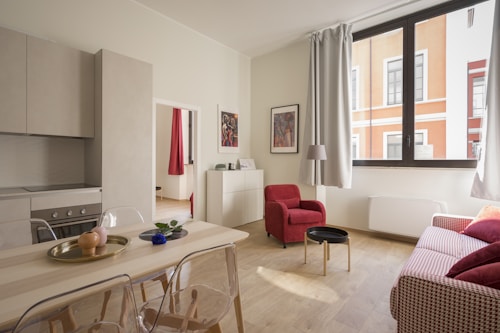
* Seamless Transition: You can move straight into school-managed housing upon arrival, complete with essential furnishings and utilities.
* Affordability: Staying in the school's dormitory is significantly cheaper than renting a private apartment in Kyoto.
* Community Building: Living with classmates from around the world fosters deep friendships and allows you to practice Japanese even after classes end.
Cultural Immersion & Daily Life
Because of the "Min-Sai" philosophy, your education extends far beyond textbooks. The school organizes regular cultural events, such as:
* Experiencing traditional Kyoto crafts and arts (tea ceremonies, pottery, or kimono wearing).
* Seasonal field trips to historic temples, shrines, and local festivals (such as the Gion Matsuri).
* Interactions with local Japanese citizens, university students, and community groups, providing valuable opportunities to practice natural, colloquial Japanese.
For daily commuting, the school is incredibly bike-friendly. Most students buy a cheap bicycle (mamachari) upon arrival and use it to commute between the dormitories, the campus, local supermarkets, and the scenic Katsura River nearby.
🎓 University & Career Pathways
Kyoto Min-Sai has built a stellar reputation for guiding students into Japan's top-tier higher education institutions. The path from language student to university undergraduate or graduate researcher is supported by structured, professional counseling.
Intensive Progression Counseling
The school provides individualized counseling sessions starting early in your program. Advisors help you:
1. Select the Right Universities or Graduate Schools: Matching your academic background, EJU scores, and personal interests with institutions across Japan, particularly in the Kansai region (such as Kyoto University, Doshisha University, Ritsumeikan University, and Kyoto Institute of Technology).
2. Write Research Proposals (Kenkyu Keikakusho): Essential for graduate school aspirants. Faculty members provide one-on-one drafting support to ensure your academic writing meets Japanese standards.
3. Prepare for Interviews: Mock interviews are conducted repeatedly to build your confidence, refine your honorific language (keigo), and teach you proper Japanese interview etiquette.
Science Track Advantages
Because of the school’s specialized science support, graduates have a distinct competitive advantage when applying to engineering, IT, medical, and agricultural departments. Kyoto is a major hub for high-tech industries (home to headquarters like Nintendo, Kyocera, Shimadzu, and Nidec), making it an ideal city to launch a scientific or technical career.
💡 Practical Tips for Applicants
If you are ready to apply to Kyoto Min-Sai Japanese Language School, keep these practical tips in mind to ensure a smooth transition:
- Plan Around the Right Intake Month:
- If you need to start from zero and want the maximum time to prepare for university exams, the April (2-Year) intake is highly recommended.
- If you already have basic Japanese skills (JLPT N4 or N3) and want a faster track, the October (1.5-Year) or January (1 Year, 3 Months) intakes are excellent options.
- Prepare Your Visa Documents Early: Japan's immigration process is thorough. You will need to provide proof of financial sponsorship and prior Japanese language study (usually at least 150 hours of study or an entry-level certificate like JLPT N5, NAT-TEST, or J-TEST) to secure your Certificate of Eligibility (COE).
- Take Advantage of the Dormitories: Strongly consider booking a school dormitory for at least your first six months. It eliminates the stress of apartment hunting from abroad and gives you a soft landing in Japan.
- Embrace the Bicycle Culture: Ukyo-ku and the surrounding areas are flat and exceptionally easy to navigate by bicycle. Buying a bike will save you thousands of yen in train fare and allow you to explore the hidden alleyways and scenic riverside paths of Kyoto at your own pace.
- Leverage the Hankyu Line: Since the school is close to Nishikyogoku Station on the Hankyu Line, you can easily commute to part-time jobs in either central Kyoto or Osaka. Part-time work is a fantastic way to pay for daily expenses while practicing your Japanese in real-world settings.
Related study abroad guides
Was this page helpful?
Your feedback helps us improve our guides