Tokyo Student Apartments & Dorms in Japan
Find student apartments in Tokyo and dorms at Japanese universities: costs, no-guarantor options, and what international students should book first.
Most Japanese universities offer some on-campus or affiliated dormitories, but spots are limited and often reserved for first-year or exchange students, so many international students end up renting private student apartments or share houses instead. In Tokyo, options range from single-room studios to shared houses, and some listings don't require a Japanese guarantor, which is a common hurdle for newcomers.
If you're weighing dorms vs. apartments for rent, dorms tend to be cheaper and come furnished but have stricter rules and shared common spaces, while private apartments and share houses offer more independence and more flexible lease lengths.
Most international students in Japan start in a university dormitory or a share house — not a private apartment. Both are furnished, skip the Japanese guarantor in most cases, and cost far less to move into than a Tokyo rental.
If you are searching for student housing in Tokyo (or Osaka/Kyoto) before your COE or school dorm assignment, use the table below, then pick one path. For operators that book in English with no guarantor, see Tokyo student housing operators.
At-a-Glance: Student Housing Options in Japan
To help you make an immediate, informed decision, the table below summarizes the key trade-offs between the three primary options for student housing in Japan.
| Feature | University/Private Dormitories | Share Houses | Private Apartments |
|---|---|---|---|
| Average Monthly Cost | ¥40,000 – ¥80,000 | ¥50,000 – ¥90,000 | ¥60,000 – ¥120,000+ (Higher in Tokyo) |
| Upfront Costs | Very Low (¥10,000 – ¥50,000) | Low (¥20,000 – ¥50,000) | Very High (3 to 5 months' rent) |
| Privacy Level | Low to Medium | Medium (Private room, shared spaces) | High (Fully private) |
| Social Opportunities | High (Built-in student community) | High (International & Japanese mix) | Low (Requires proactive effort) |
| Guarantor Required? | No | Rarely | Yes (Usually a guarantor company) |
| Furnished? | Yes | Yes | No (Typically completely empty) |
| Minimum Lease Term | Flexible (By semester/year) | Highly Flexible (1 to 3 months minimum) | Rigid (Usually 2-year contract) |
Student housing in Tokyo
Tokyo student accommodation is expensive next to campus and cheap if you accept a 30–40 minute commute.
- Central (Shinjuku, Shibuya, Takadanobaba): a tiny studio often runs ¥90,000+ per month. Language-school students cluster here; share houses are usually the only no-guarantor option at that location.
- 30–40 minutes out (Seibu Shinjuku, Odakyu, Toei Mita): rent often falls to ¥55,000–¥70,000. University dorms and private student dorms (Dormy / WID) are more common on this belt.
- April intake: start looking by January. October intake is quieter but still books out near popular schools.
Utilities are bundled in most dorms and share houses. In a private apartment they are not — summer/winter AC can add ¥15,000–¥20,000.
1. Dormitory for international students
For incoming international students, a school-affiliated or private student dormitory (ryo) is the softest landing. These facilities are built to ease the first months in Japan.
School-Managed vs. Private Student Dorms
Most universities offer dedicated dormitories for international students. These may be on-campus or a short commute away. Additionally, companies like Kyoritsu Maintenance (which operates WID and Dormy residences) partner with universities to provide high-quality private student dorms.
- Pros: Outstanding safety, built-in peer support, and often include meal plans (breakfast and dinner). Utilities and high-speed internet are typically bundled into a flat monthly fee.
- Cons: Curfews (monpen) are common, guest policies are strict (often banning overnight visitors entirely), and common areas are shared.
What to Expect in a Japanese Dorm
Dormitories generally offer single or shared rooms equipped with a desk, bed, wardrobe, and mini-fridge. Bathrooms, kitchens, and laundry facilities are usually communal. Some premium private dormitories offer ensuite bathrooms but maintain shared social lounges to foster community.
2. Share house for international students in Japan
If you want a private room without a Japanese guarantor, a share house for international students in Japan is the usual next choice after (or instead of) a school dorm. Operators such as Oakhouse, Borderless House, and GG House book in English and are common in Tokyo, Osaka, and Kyoto.
How Share Houses Work
In a share house, you rent a private bedroom while sharing the kitchen, living room, bathrooms, and showers with other residents. Major operators—such as Oakhouse, Borderless House, and GG House Club—actively curate an international environment, often aiming for a 50/50 split between foreign students and young Japanese professionals.
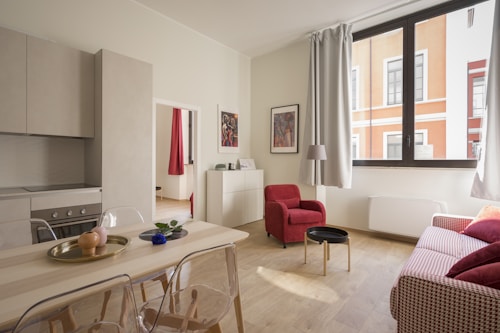
Typical layout: private bedrooms (bed, desk, AC) plus shared showers/bathrooms, kitchen, and a common lounge/dining area.
Why Students Choose Share Houses
- No Guarantor Needed: You do not need a Japanese guarantor or guarantor company.
- Furnished Rooms: They come equipped with a bed, desk, chair, and air conditioner.
- Low Initial Costs: The traditional initial fees are replaced by a simple administration/contract fee (typically ¥30,000 to ¥50,000).
- Built-in Language Practice: Living with native Japanese residents provides natural, daily opportunities to practice conversational Japanese.
3. Private Apartments: Ultimate Independence and Privacy
Renting a private apartment (apaato or mansion) provides complete freedom, but it comes with the steepest financial and administrative barriers. This option is best suited for long-term students (staying 2+ years) with conversational Japanese skills or access to bilingual support.
The Real Estate Barrier for International Students
The traditional Japanese rental market can be challenging for foreign residents. Some landlords hesitate to rent to students due to language barriers or concerns over lease terms. However, specialized expat-friendly agencies (such as GaijinPot Housing, Plaza Homes, and Real Estate Japan) cater specifically to international renters, offering fully bilingual support.
Key Apartment Classifications in Japan
- Apaato (Apartment): Typically two-story wood-frame or light-gauge steel buildings. They offer cheaper rent but have thinner walls (less soundproofing) and poorer insulation.
- Mansion (Condominium): Multi-story buildings constructed with reinforced concrete. They offer superior soundproofing, security (auto-lock gates), and insulation, but come with higher rent and communal maintenance fees (kanrihi).
Upfront Costs Demystified: The Financial Reality
When planning your Tokyo student accommodation budget, you must account for initial fees. While dorms and share houses keep these minimal, traditional apartments require a significant upfront investment.
Understanding Japanese Real Estate Terminology
- Shikikin (Deposit): Usually 1 to 2 months' rent. It is used to cover repairs and cleaning when you move out; the remainder is returned.
- Reikin (Key Money): A non-refundable gratuity paid to the landlord, usually 1 to 2 months' rent. This is a traditional custom, though "zero-reikin" properties are becoming more common.
- Chukai Tesuryo (Agency Fee): The commission paid to the real estate agent, typically capped at 1 month’s rent plus tax.
- Hoshonryo (Guarantor Company Fee): A fee paid to an agency to act as your co-signer, usually costing 50% to 100% of one month’s rent.
- Fire/Disaster Insurance: Mandatory insurance, typically costing ¥15,000 to ¥20,000 for a two-year lease.
Upfront Cost Scenario Comparison
To illustrate the difference, here is an estimation of upfront costs for a property with a monthly rent of ¥70,000.
| Fee Category | Private Apartment (Traditional) | Share House | University Dormitory |
|---|---|---|---|
| First Month's Rent | ¥70,000 | ¥70,000 | ¥70,000 |
| Shikikin (Deposit) | ¥70,000 (1 month) | ¥0 – ¥30,000 | ¥20,000 (Refundable) |
| Reikin (Key Money) | ¥70,000 (1 month) | ¥0 | ¥0 |
| Agency Fee | ¥77,000 (incl. tax) | ¥0 | ¥0 |
| Guarantor Fee | ¥35,000 – ¥70,000 | ¥0 | ¥0 |
| Lock Exchange Fee | ¥15,000 – ¥22,000 | ¥0 | ¥0 |
| Insurance | ¥20,000 | Included in utilities | Included in utilities |
| Estimated Total Upfront | ¥287,000 – ¥329,000 | ¥70,000 – ¥100,000 | ¥90,000 |
Navigating the Guarantor System
If you decide to rent a private apartment, you will encounter the guarantor (hoshonin) requirement. In Japan, landlords require a guarantor to co-sign the lease and take financial liability if you fail to pay rent or damage the property.
How it usually works: you sign a lease with the landlord, and either a Japanese joint guarantor (rare for international students—often a relative with stable income in Japan) or a guarantor company (e.g. GTN, J-Lease) backs the lease for a fee, typically about 50%–100% of one month’s rent.
What are your options as an international student?
- Guarantor Companies (Hoshonin-Gasha): This is the standard modern solution. For a fee, these companies act as your guarantor. Your real estate agent will typically introduce you to a guarantor company that they partner with (such as GTN, which specializes in supporting foreign residents).
- School Guarantor Schemes: Some Japanese universities offer institutional guarantor support (Gakusei Sogo Hosho) for students who meet specific academic and visa requirements. Check with your university’s international student office early, as policies vary.
Student Housing Decision Checklist
Use this step-by-step checklist to determine which housing path matches your profile:
- [ ] Step 1: Calculate Your Total Initial Budget.
- Under ¥150,000? Focus exclusively on university dorms or share houses.
- Over ¥300,000? Private apartments are financially viable.
- [ ] Step 2: Determine Your Stay Duration.
- 1 Semester to 1 Year: A share house or university dorm is highly recommended due to flexible contract terms.
- 2+ Years (Full Degree): A private apartment becomes cost-effective over time as the initial fees amortize.
- [ ] Step 3: Evaluate Your Language Proficiency.
- Beginner (JLPT N5/N4): Opt for university housing or expat-friendly share houses with English-speaking staff.
- Intermediate/Advanced (JLPT N3+): You can confidently navigate local real estate agencies and manage utility setups independently.
- [ ] Step 4: Assess Your Privacy and Social Needs.
- I need absolute quiet and my own space: Look for a private apartment or a premium studio-type share house.
- I want to make friends and practice Japanese immediately: A share house or interactive dormitory is the ideal match.
Where to look next
- Tokyo student housing operators — share houses, guesthouses, and monthly mansions that take international students without a personal guarantor.
- Ask your school’s international office before you pay a private agent. Many universities hold dorm rooms until a set deadline; missing that date is how students end up in a last-minute share house (which is still a valid plan).
Related study abroad guides
Was this page helpful?
Your feedback helps us improve our guides